
What Is Cash Flow? The Equation Behind Every Budget
One line of math, pictured as a bathtub, is the foundation for everything else in personal finance.
Published Updated 4 min read
In this article8 sections
What is cash flow?
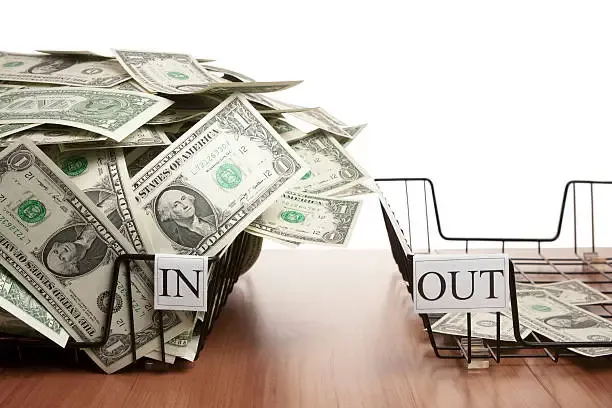
Cash flow is the money that comes in minus the money that goes out. If more comes in than goes out, you have positive cash flow, and that leftover is what you can save, invest, or use to pay down debt. If more goes out than comes in, you have negative cash flow, and the gap gets covered by savings or debt.
Here's the whole equation:
Income − Expenses = Cash Flow
That's it. It's the simplest math in personal finance, and it's the foundation for everything else: budgeting, emergency funds, investing, retirement. It's the first number I look at whenever I'm planning our family's money.
Picture a bathtub
Think of your money as water in a bathtub.
- The faucet is your income: your paycheck after taxes, plus any side income.
- The drain is your expenses: rent or mortgage, groceries, car payment, subscriptions, that coffee.
- The water level is what you have. Your cash flow is whether that level is rising or falling each month.
If the faucet pours in faster than the drain empties, the tub fills up. That's positive cash flow. If the drain runs faster than the faucet, the level drops. That's negative cash flow.
A round-number example
Say the faucet brings in $4,000 a month after taxes, and the drain lets out $3,500 a month:
| Monthly | |
|---|---|
| Income (faucet) | $4,000 |
| Expenses (drain) | −$3,500 |
| Cash flow (water level change) | +$500 |
The tub rises by $500 every month, or $6,000 a year. That $500 is what builds an emergency fund, a down payment, or a college fund for your kid.
Now flip it. If expenses creep up to $4,300, cash flow is −$300 a month. The tub is draining $3,600 a year.
How do you spend more than you make?
It sounds impossible to pour out more water than comes in, but it's easy when something hides the gap. The usual culprits:
- Credit cards that you don't pay off in full each month.
- Payday loans and "buy now, pay later" plans.
- Dipping into savings without noticing.
These feel like extra water in the tub, but they're borrowed water, and it has to be paid back with interest. Credit card interest is expensive: in the second quarter of 2026, the average rate on credit card accounts that were charged interest was 22.15%, according to the Federal Reserve's G.19 consumer credit report. Borrowed water makes the drain bigger next month.
What does cash flow look like for real households?
The real numbers work the same way as the round ones, just bigger. According to the Bureau of Labor Statistics' Consumer Expenditure Survey for 2024, the average U.S. household:
- Had $104,207 of income before taxes
- Spent $78,535 over the year
Most of that spending went down three drains:
| Expense | 2024 average | Share of spending |
|---|---|---|
| Housing | $26,266 | 33.4% |
| Transportation | $13,318 | 17.0% |
| Food | $10,169 | 12.9% |
Keep in mind that the income figure is before taxes, and the spending figure doesn't include income taxes, so the gap between them isn't all savings. A better measure of what's left over is the personal saving rate: in July 2026, Americans saved 3.0% of their after-tax income, according to the Bureau of Economic Analysis. That's about $3 of every $100 that came through the faucet. On average, the tub is barely rising.
How do you improve your cash flow?
Looking at the equation, there are only two levers:
Open the faucet (increase income):
- Ask for a raise, or look at what your skills are worth elsewhere. (And don't worry about a raise pushing you into a higher tax bracket. It always leaves you with more money.)
- Pick up a side gig or freelance work.
- Sell things you don't use anymore.
Plug the drain (reduce expenses):
- Cancel subscriptions you've forgotten about.
- Call your insurance, phone, and internet providers and ask for a better rate.
- Pay off high-interest debt, which shrinks the drain for good.
Small changes on either side add up. Cutting $100 a month is $1,200 a year more in the tub.
Why cash flow is the foundation
Every money goal is really a cash flow goal. An emergency fund, a car in a few years, a house, your child's college, retirement: each one needs the tub to be rising, and rising on purpose.
Businesses know this well. A company can have a great product and great people, but if more money goes out than comes in, it's in trouble. Your household is no different.
There are two halves to getting it under control:
- Know where the water goes. Track your spending for a month or two, with a budgeting app, your bank's spending summary, or a plain spreadsheet. Most people are surprised by at least one drain.
- Make a plan for it. That's a budget: deciding ahead of time how much goes to each drain, and how much stays in the tub. Most people roll their eyes at the word, but making one, and more importantly sticking to it, is the single best way to get your expenses under control.
What to take with you
- Cash flow = income − expenses. If the number is positive, your tub is filling. If it's negative, it's draining, even if a credit card hides it for a while.
- Find your number. Add up last month's take-home pay and last month's spending. The difference is your monthly cash flow.
- Pick one lever. Choose one way to open the faucet or plug the drain this month, like canceling one subscription or calling one provider.
- Give the extra a job. Decide where your positive cash flow goes (an emergency fund first, then goals like retirement) so it doesn't quietly drain away.
- Talk about it. If you share finances with a partner, look at the tub together. It's a lot less awkward when it's just one number.
Want to see how taxes shape the water coming out of your faucet? Read how tax brackets actually work, or try the calculators.